
Quick question: when did you last update your About page?
If you had to think about it, you are in good company. For most of us, the About page is the thing we threw together when we first launched, promised ourselves we would fix later, and then never touched again.
But your About page is not a formality. It is often the page a brand visits before deciding whether to email you, the page a potential client reads before booking, and the page a reader lands on right before deciding whether to subscribe or click away. It is doing real work whether you have optimized it or not.
So let’s make it count. This guide walks through how to write an About page that actually moves people to act, whether you are a photographer, a fitness coach, a travel creator, a maker, a podcaster, or anything in between.
Focus on the Strategy
This is the step almost everyone skips, and it is the one that separates a strategic About page from a nice-to-read one.
Before you write a single sentence, answer this: What do you want a stranger to do after reading it?
Here are a few examples:
- A content creator wants companies to see professionalism, reach, and a clear niche, then reach out. Your page should make your value obvious and your contact info easy to find.
- A service provider (photographer, designer, coach, consultant) wants a visitor to trust them enough to book a call. Your page should build credibility fast and point clearly toward “work with me.”
- A product seller or maker wants the story behind the work to make the product feel worth buying. Your page should connect your craft to your why.
- A writer or creator building an audience wants one thing above all: the newsletter signup. Everything should funnel there.
You can absolutely have more than one goal. But you should know your primary one, because that goal decides what goes at the top, what gets cut, and what your closing call to action says. An About page that tries to do everything usually does nothing.
The Anatomy of a Strong About page
Once you know your goal, here is the structure that consistently works. Think of it as a flexible framework, not a rigid form. Take what fits your work and leave the rest.
Lead with the Essentials
The top of your page should answer “who is this and why should I care” within a few seconds. Include:
- Your name, written exactly as it appears across your bylines and social profiles.
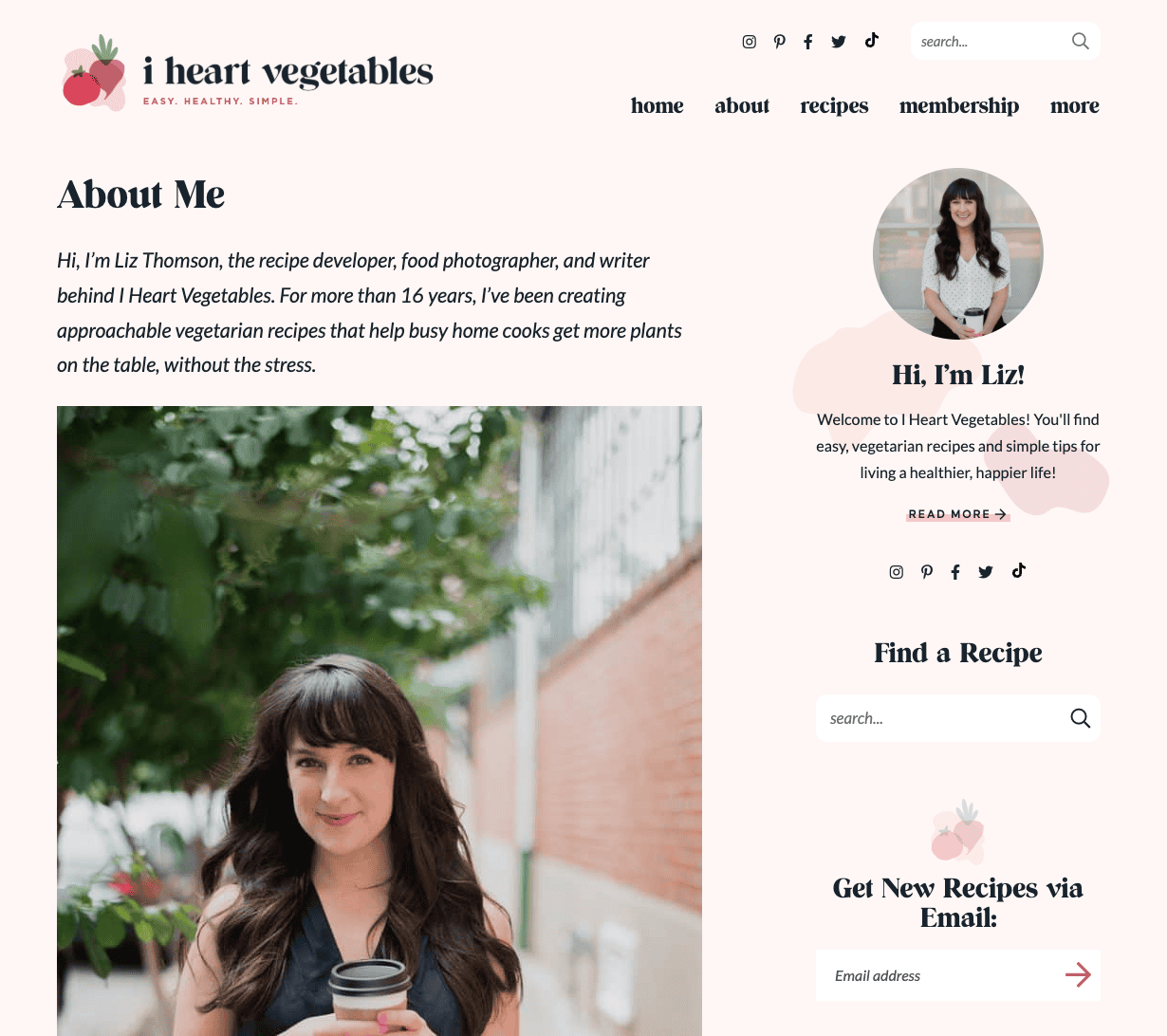
- A real photo of you. Use the same headshot you use on your social accounts so people (and search engines) connect the dots. A face builds trust in a way a logo never will.
- A one-line positioning statement. Not your life story, just the clearest possible version of what you do and who you do it for. “I’m a Richmond wedding photographer who specializes in relaxed, candid storytelling” tells me more than three paragraphs of throat-clearing.
- Your location, if it is relevant to your work. For anyone serving a local market, this is not optional; it is a selling point.
Show your Experience
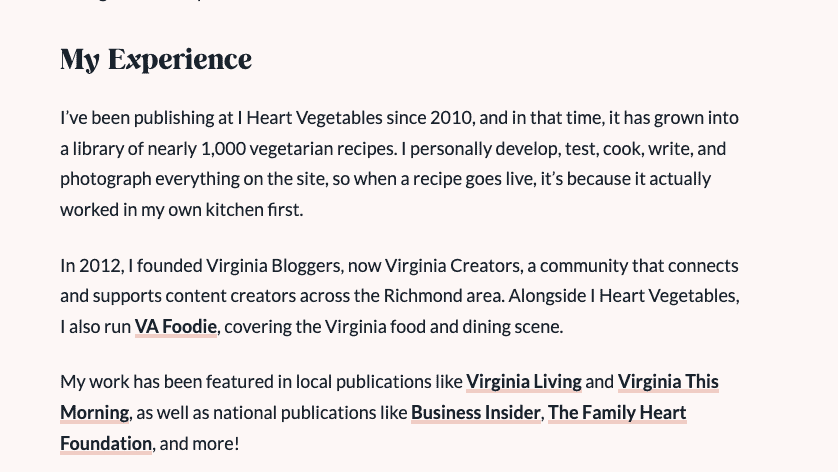
This is where you prove you have actually done the thing. Walk through your background, your notable projects, the years you have been at it, and any standout collaborations or clients. Numbers help when you have them: years in business, projects completed, people served, episodes published. If you have been featured anywhere, name it, and link to it so it is verifiable rather than just a claim. Here’s a snippet from my About page:
Name your Expertise
Be specific about your areas of focus. A short, scannable list works well here. A maker might list “hand-thrown ceramics, small-batch production, custom commissions.” A coach might list “strength training, habit building, working with beginners.” Specificity is what makes you findable and memorable. “I do a little of everything” is the fastest way to be hired for nothing.
Share your Credentials
Degrees, certifications, training, or relevant professional history all belong here. And if you are self-taught, say so with confidence. There is nothing weak about “I am a self-taught designer who has spent eight years learning by doing.” Demonstrated experience is its own credential, and honesty reads as trustworthy.
Highlight your Profiles
Link your verified profiles, the ones you actually keep active. Place the icons somewhere obvious, near the top or bottom of the page. This does double duty: it helps readers follow you, and it helps search engines confirm that the person behind the content is a real, established creator.
Add a Personal Touch
This is what turns a resume into a connection. A few details about your life outside the work, a fun fact, and what got you into this in the first place give readers a reason to root for you. Share only what you are comfortable making public, but don’t skip it entirely. People support people they feel they know.
Close with one clear call to action
End by telling people exactly what to do next, and make it match your goal from step one. “Follow along on Instagram.” “Sign up for my newsletter.” “Book a discovery call.” One primary ask, stated plainly. If you make readers guess what to do next, most of them will do nothing.
Write for Humans but Don’t Ignore Google
Here is something worth understanding, especially if any part of your income depends on search traffic. Google uses a framework called E-E-A-T, which stands for Experience, Expertise, Authoritativeness, and Trustworthiness. In plain terms, Google wants to know there is a real, qualified person behind your content.
Your About page is one of the strongest signals you can send. A page that clearly establishes who you are, what you are qualified to talk about, and that links out to your verified profiles and press helps search engines trust your whole site, not just that one page.
If you want to go a step further on the technical side, you can add the ProfilePage schema, which is a small piece of structured data that formally tells Google “this page is about this person.” Many website platforms and SEO plugins can add it for you with a setting or two, and tools like Google’s Rich Results Test let you confirm it is working. Don’t let the jargon intimidate you. The writing matters far more than the code.
How it Impacts Rankings
So why go to the trouble? Because a well-built About page strengthens your authority across your entire site, and that can show up in search. Google does not just rank pages, it tries to understand the people and brands behind them. The more confidently it can identify you as a real, credible creator in a specific space, the more it trusts everything you publish. Your About page is the home base for that identity. It is where you gather the proof, credentials, press, and links that tell Google “this is a known, qualified person, not an anonymous content mill.” (Because we all know those junk sites are trying to take over the internet.)
A few ways that this can play out in practice:
- Your About page lifts your other pages, not just itself. When Google can clearly connect your name and expertise to your content, it has more reason to trust your individual posts, recipes, guides, or portfolios. Authority you build on one page can benefit your whole site. (This is a reason to set up a Google Search Profile!)
- Your byline becomes a vote of confidence. If every post links your name back to a strong author page, you are repeatedly reinforcing the same message: a real, credentialed person stands behind this. Over time, that consistency builds what Google considers an established author, and established authors tend to be treated more favorably than unknown authors.
- You become a recognizable entity. When your name, photo, and verified profiles all point to the same person across the web, Google starts to treat you as a distinct, trusted source rather than a string of text. That recognition is the foundation of authority, and it is built largely through the signals an About page organizes in one place.
- It compounds. A strong About page today, kept current and linked consistently, pays off more and more as your body of work grows.
Keep in mind, an About page is not a magic ranking button, and anyone who promises you otherwise is overselling it. Great content, earned links, and real expertise still do the heavy lifting. But your About page is the piece that ties it all together and tells search engines exactly who deserves the credit. For something that takes an afternoon to get right, that is a strong return.
A few mistakes to avoid
- The wall of text. Break things up with short paragraphs, lists, and a photo or two. Nobody reads a dense block.
- All personality, no proof. Charm is great, but a brand or client needs to see that you can deliver. Balance the warmth with substance.
- All proof, no personality. The opposite problem. A list of credentials with no human behind it does not earn connection.
- No photo. Add one. It is the single easiest trust-builder on the page.
- No call to action. If you do not tell people what to do next, they will leave. Always close with an ask. (Book a call, sign up for an email list, etc.)
- Writing it once and forgetting it. Your work evolves. Your About page should too. Put a reminder on your calendar to revisit it once or twice a year.
A Sample Template
If you are staring at a blank page, fill in these blanks and you will have a working draft:
Hi, I’m [name], a [what you do] based in [location] who helps [who you serve] with [the result you create].
For the past [number] years, I’ve [brief experience, key projects, or proof]. My work focuses on [two or three areas of expertise], and [a credential, certification, or honest note on how you got here].
When I’m not [doing your work], you’ll find me [one or two personal details].
[Your one clear call to action.]
Start there, expand the sections that deserve more room, and cut anything that does not serve your goal.
Ask for Feedback
If you want a second set of eyes on your draft, or you are stuck on how to position what makes you different, this is exactly the kind of thing our Virginia Creators community is here for. Share your draft, swap feedback, and steal ideas from creators in every niche.
Your About page is one of the hardest-working pages you have. Give it an afternoon, and let it start working for you.aft, swap feedback, and steal ideas from creators in every niche.
Your About page is one of the hardest-working pages you have. Give it an afternoon, and let it start working for you.